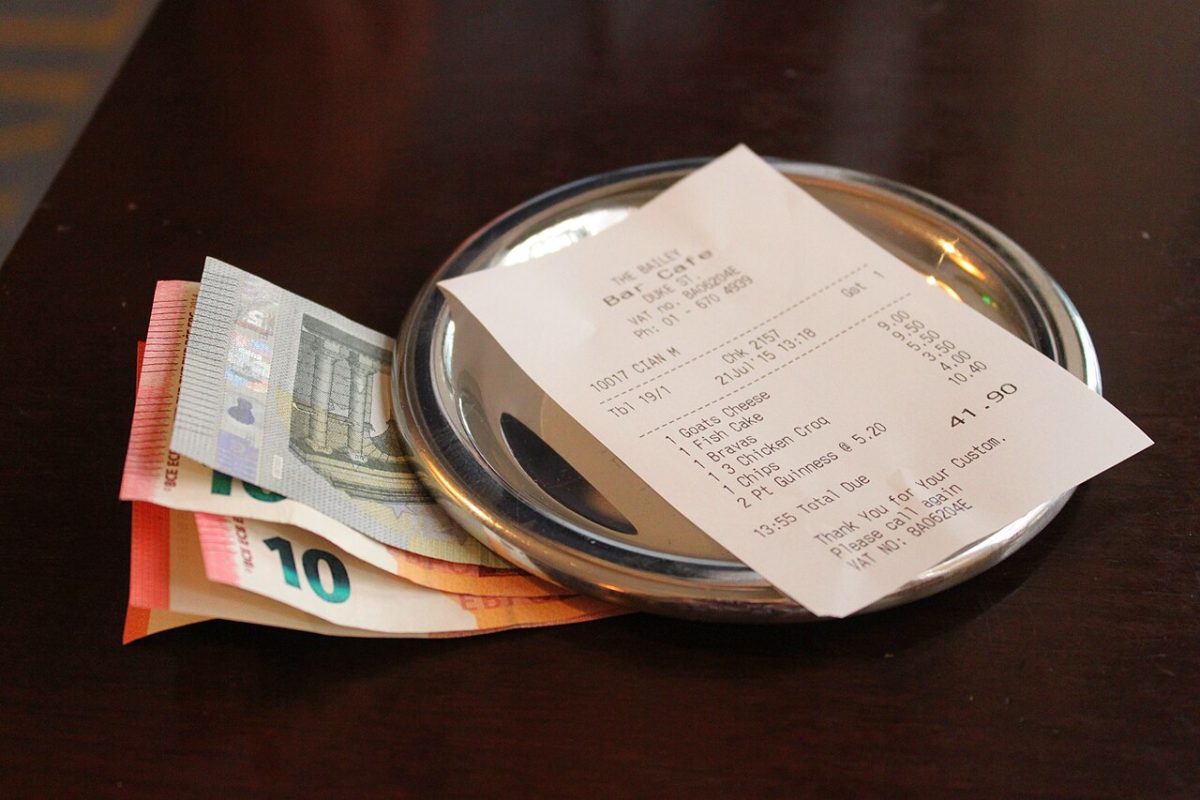
The difference between a service charge and a tip is who decides. A tip is money you choose to leave, in an amount you pick. A service charge is a fee the restaurant sets and adds to the bill, even when it is called an “automatic gratuity”. That one difference changes who the money legally belongs to, how it is taxed and whether you are expected to add anything on top.
Key facts
- The IRS says a payment is a tip only if the customer voluntarily decides to pay it and sets the amount.
- A mandatory 18% charge for large parties is a service charge, not a tip, whatever the menu calls it.
- Service charges passed to staff are treated as wages; tips belong to the employee who receives them.
- The federal “no tax on tips” deduction (2025 to 2028) covers voluntary tips only, not service charges.
- In California, a restaurant may add a mandatory fee only if it is clearly shown wherever prices are shown.
What is the difference between a service charge and a tip?
The IRS page on tip recordkeeping and reporting sets out the test plainly: if the customer voluntarily decides to pay and determines the amount, it is a tip. If you can write in any amount or leave the tip line blank, what you leave is a tip. The IRS also says the label does not settle it: calling a payment a “tip” does not make it one.
The same page lists examples of service charges: automatic charges added to a bill, such as a mandatory 18% charge for large parties; required gratuities written into a contract or invoice, which is common for private events and catering; and digital payment screens that will not let you finish paying unless you choose a tip above zero.
| Tip | Service charge | |
|---|---|---|
| Who sets the amount | You | The restaurant |
| Can you leave nothing? | Yes | No, it is part of the bill |
| Who it belongs to | The employee (or a valid tip pool) | The business, which may share it with staff |
| Tax treatment for staff | Tip income, reported by the worker | Wages, if the business pays it out |
| Counts for the federal tips deduction? | Yes, if other conditions are met | No |
Does the server get the service charge?
Not necessarily. A tip legally belongs to the worker. The Labor Department’s fact sheet on tipped employees says employers, including managers and supervisors, may not keep any part of employees’ tips, whether directly or through a tip pool. The same fact sheet is equally clear that a compulsory charge for service, for example 15 percent of the bill, is not a tip under federal wage law.
Because a service charge is the restaurant’s revenue, the business decides what happens to it. Some pay all of it to the servers who worked the table, some split it across front and back of house, and some use part of it for wages or benefits generally. When it is paid to staff, the IRS says it must be treated as wages. A few cities and states add their own rules about disclosing where a service charge goes, so the honest answer for any one restaurant is: ask.
Should you tip on top of a service charge?
It is your choice, and that is the point of a tip. A reasonable approach is to read the menu or the bill for an explanation of the charge. If it says the charge goes to the service team and replaces tipping, many diners add nothing or a small amount for exceptional service. If it describes a fee for something else, such as kitchen wages, health benefits or rising costs, the server may receive none of it, and you may want to tip as you normally would.
It is fine to ask your server politely how the charge works. Staff hear the question often, and how they answer tells you a lot about the restaurant’s policy. Our walkthrough of one night of dinner service shows how many people a single table’s bill can end up supporting.
Why do restaurants add service charges at all?
Large parties are the classic case. A table of ten ties up a server for hours and splits the check in ways that can leave the tip short, so many restaurants add a set percentage for groups above a certain size. Private events and banquets often include a contract gratuity for the same reason. Other restaurants use a service charge to move away from tipping altogether, paying staff a higher fixed wage, or to share income more evenly between servers and cooks. Pricing policies like this sit alongside deposits and cancellation fees, which we cover in our guide to how booking and no-show policies work.
Do restaurants have to tell you about a service charge in advance?
Rules vary by place. California is a clear example: its hidden-fees law took effect on July 1, 2024, and the Attorney General’s guide to the law explains that mandatory restaurant fees are allowed only if they are clearly and conspicuously displayed wherever prices are shown. Voluntary tips are not affected. Elsewhere, consumer protection laws on deceptive pricing generally apply, so a surprise charge that was never disclosed is worth raising with a manager.
What about the new federal “no tax on tips” deduction?
For tax years 2025 through 2028, eligible workers can deduct up to $25,000 a year of qualified tips, with the deduction phasing out above $150,000 of modified adjusted gross income ($300,000 for joint filers), according to the IRS fact sheet on the new deductions. Qualified tips are voluntary cash or charged tips, and the IRS tip page states that service charges are not eligible. For servers, that makes the line between a tip and a service charge matter more than it used to. This is general information, not tax advice; workers should check their own situation with a tax professional.
Frequently asked questions
Is an automatic gratuity a tip?
No. If the restaurant adds it and you cannot change the amount, the IRS and the Labor Department treat it as a service charge, even if the bill calls it a gratuity.
Can I ask to have a service charge removed?
You can ask, especially if it was not disclosed or the service was poor, but a properly disclosed charge is part of the price. Raise it with a manager rather than the server, who usually has no say in the policy.
Is a tip prompt on a payment screen a service charge?
Only if it forces you to pick an amount above zero. If you can choose “no tip” or enter your own amount, what you leave is a tip. If the screen will not let you finish without tipping, the IRS treats that payment as a service charge.
Do kitchen staff share in tips?
They can. Federal rules allow tip pools that include cooks and dishwashers in some cases, but managers and supervisors generally cannot take part. Service charges are different, because the business decides how to share them.
What is a normal large-party service charge?
There is no legal standard. The IRS uses 18% for parties as its example, and many restaurants set something in that range, but the menu or reservation terms tell you the exact figure and the party size it applies to.
The short version
If you choose the amount, it is a tip and it belongs to the staff. If the restaurant sets it, it is a service charge and the business decides where it goes. Read the menu, ask how the charge is shared, and tip on top if you want to. To see who does what on the floor, read our guide to front of house roles or browse more Front of House guides.
Featured photo: Pay the bill by Benreis, CC BY 3.0.